
Did Rava Join the Opposition to His Teacher?

Chullin deals particularly with laws of shechita, but underlying principles have wide application to all of halacha. Chullin 10a reports on a dispute between Rav Huna and Rav Chisda. Rav Huna was a student of Rav in the second generation of Amoraim and took over leadership of Sura academy after Rav’s death. Rav Chisda was Rav’s student and then Rav Huna’s student and colleague, and helped lead Sura academy together with Rav Huna’s son (Rabba bar Rav Huna) after Rav Huna’s death. We therefore consider Rav Chisda as both a second and third-generation Amora. A dispute between Rav Huna and Rav Chisda, situated in Sura academy in the second generation, is a common occurrence.
The case under discussion is of a knife used for shechita which was then found to be notched. If the notch was present during shechita, the shechita was invalid. As Rashi elaborates, the knife had been inspected prior but not immediately after. Thus, there was a chazaka, or presumption of continuation of the status quo, that the knife was valid. On the other hand, we have a notched knife before us. Rav Huna says that even if, after the shechita and before inspecting the knife, he used the knife all day to break bones – such that we could quite reasonably attribute the notch to impact with a bone – we deem the shechita invalid, since we fear that impact with the animal’s hide before shechita caused the notch. Rav Chisda deems the shechita valid, for perhaps a bone caused the notch in the knife.
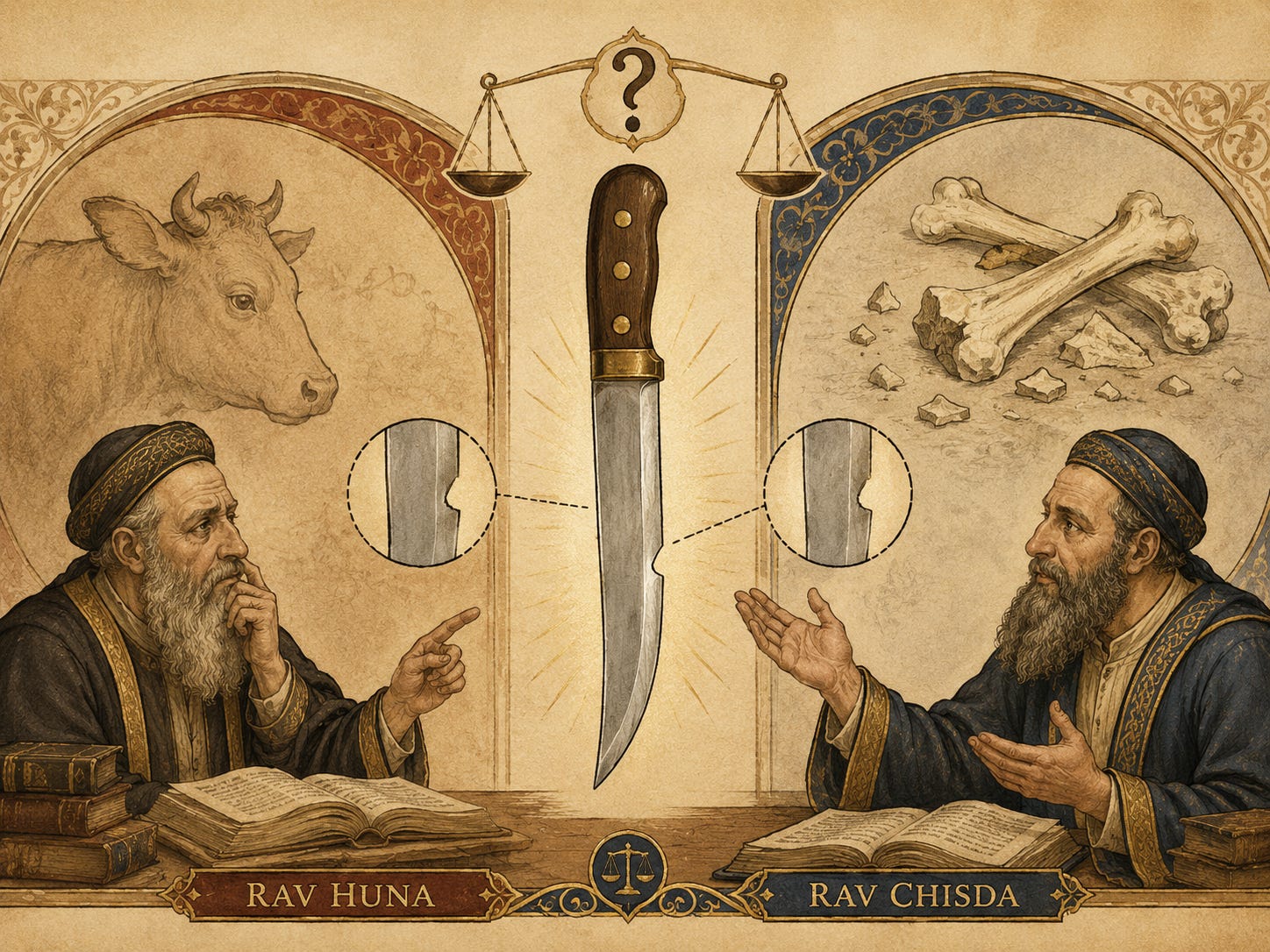
There is a brief interjection by the Talmudic Narrator, operating in a later era, framing the principles at play. For Rav Huna, this is either his stated concern here about hide or Rav Huna’s assumption from Chullin 9a that any live animal has a prior presumptive status of prohibition. For Rav Chisda, it is that bones can certainly notch a knife, while hides might notch a knife, and the certainty overrides an uncertainty about which caused the notch. Note that Rav Chisda does not explicitly enunciate this principle. Rather, the phrase אָמַר לָךְ is the Talmudic Narrator’s suggestion of what Rav Chisda might have said to you, were he still alive and participating in the conversation.
Attacking His Father-in-Law?
Then, Rava chimes in with a brayta, attacking Rav Chisda and supporting Rav Huna. מֵתִיב רָבָא לְסַיּוֹעֵיהּ לְרַב הוּנָא. We won’t analyze the brayta here, or on what basis Rava believes the brayta supports Rav Huna or attacks Rav Chisda – whether it just happens to match attributing cause to prior or subsequent events, or whether it also involves certain vs. uncertain attribution, something seemingly only spelled out by the Talmudic Narrator.
Rather, I am interested in the fact of Rava supporting Rav Huna instead of Rav Chisda, and in the language of מֵתִיב לְסַיּוֹעֵיהּ. Rava is a fourth-generation Amora and presumably never interacted with Rav Huna. After all, Kiddushin 72b describes how, when second-generation Rav Yehuda (bar Yechezkel) was dying, Rava was born. Rav Yehuda and Rav Huna were of the same generation, while Rav Chisda lived for decades after. An elderly Rav Chisda was one of Rava’s teachers. Rava eventually married Rav Chisda’s daughter.
Rava certainly does not always agree with Rav Chisda, and Amoraim can generally disagree with their teachers. Still, I might expect that study with one’s teacher would shape a student’s halachic worldview, such that in external disputes, a student would tend to side with the teacher. This is something that deserves an in-depth study.
Regardless, that was my first thought in the intent of מֵתִיב לְסַיּוֹעֵיהּ, that Rava attacking Rav Chisda is out of the ordinary. A better alternative is that the word מֵתִיב alone is ambiguous when reacting to two Amoraim arguing, so לְסַיּוֹעֵיהּ simply tells us with whom this later Amora aligns. The phrase appears elsewhere only in Zevachim 10a, where Rabbi Yirmeya responds / attacks in support of Rabbi Yochanan, while Rabbi Illa responds in support of Reish Lakish; and in Yoma 42a, where Rabbi Yehoshua bar Abba attacks Shmuel’s position in support of Rav.
This becomes exceptionally clear once we realize that “Rava” in our sugya is a printing error. Venice, Soncino and Vilna printings have fourth-generation Rava. However, Munich 95 has third-generation “Rabba”. The Toledo printing and the Hamburg 169, Vatican 121, and Vatican 122 manuscripts all agree on “Rabbi Abba”. Given that “Rabbi Abba” is less common than Rabba or Rava, “Rabbi Abba” is the stronger reading under the principle of lectio difficilior potior. This would surely be Rabbi Abba I, a second- and third-generation Babylonian Amora, who was Rav Huna’s and Rav Yehuda’s student, and who eventually moved to the Land of Israel. Rabbi Abba supports Rav Huna, his teacher. It could potentially also be Rabbi Abba II, a fifth-generation Amora from the Land of Israel who descended to Babylonia, or Rabbi Abba III, a sixth-generation Amora who likewise descended to Babylonia in Rav Ashi’s day, but an identification with Rabbi Abba I makes the most sense, given his temporal proximity to those already in the conversation.
His Earlier Appearance
Further, in an earlier and related sugya on Chullin 9a, this Rabbi Abba I had already made an appearance. There, Rabbi Abba inquired of Rav Huna: If a wolf came and took the innards of a slaughtered animal, what is the law? (As properly recalibrated by the Talmudic Narrator, the question is this. Yes, the innards have a presumption of validity. Still, say a wolf grabbed the innards, and they were retrieved and found to be without flaw other than the wolf’s punctures, need we worry that there was a preexisting puncture in the place of the wolf’s puncture?) Rav Huna dismisses the concern. Rabbi Abaye then attacks Rav Huna’s answer, comparing it to a brayta discussing an animal nibbling fruit, and a worry that this was where a snake had punctured it. Rav Huna then responds directly to him – danger is more stringent than prohibition. So far, these direct interactions indicate that Rabbi Abba is a second- or third-generation Amora. We also know that this very Amora moved to the Land of Israel. Yerushalmi Terumot 8:3 is a roughly parallel sugya, in which Rabbi Abba interprets a brayta about possible snake-punctured fruit, and also quotes the “Sages of There” (Babylonia, and presumably referring to Rav Huna) declaring validity even where a wolf ran off with the innards.
Back to our Bavli sugya, Rava then speaks to him (Rabbi Abba), meaning אֲמַר לֵיהּ רָבָא. Then, Abaye responds to him (him here being Rava). This would involve Rabbi Abba interacting with the fourth-generation Babylonian Amoraim. This should not be problematic for a second- and third-generation Amora, except that Berachot 24b relates how this same Rabbi Abba took his leave of his teacher, Rav Yehuda, before ascending to the Land of Israel. Further, recall that the lifetimes of Rav Yehuda and Rava did not overlap. This problem is readily resolved, because אֲמַר לֵיהּ רָבָא is a printing error. The manuscripts have the correct text of אֲמַר רָבָא, so that fourth-generation Rava simply reacted to the earlier discussion.
In conclusion, Betteridge’s law of headlines holds true. No, Rava did not join the opposition to his teacher Rav Chisda. It was Rabbi Abba I, who is active in these discussions, who came to Rav Huna, his teacher’s, defense. Careful consideration of manuscript evidence enables us to identify the correct person, and to allow for students to support their teachers in disputes.