
Mar bar Chiya the Disappearing Amora (full article)

I realized that I neglected to post the article for this past Shabbos from the Jewish Link. Here it is.
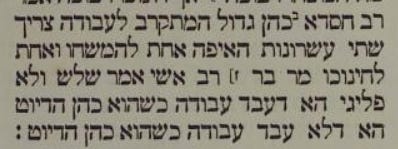
Mar bar Chiya does not appear in our Talmudic text of Menachot 78a, but he should. Rav Chisda, a third-generation Amora, says that a Kohen Gadol who approaches to perform service on the day he’s anointed must bring two menachot, thereby bringing two tenths of an eifah – one for the typical daily mincha of the Kohen Gadol and one for his inauguration. Mar bar Rav Ashi, a famous seventh-generation Amora and son of the famous Rav Ashi, argues and says that he must bring three tenths of an eifah. The Talmudic Narrator explains that this isn’t a true argument, but is rather discussing different situations. If this kohen had never served as a regular kohen, then a third mincha is necessary for his regular kohanic inauguration.
The distance in scholastic generations is striking but not impossible. Still, in your Vilna Shas, there is a footnote with a zayin and end bracket, indicating an emendation by the Shitta Mekubetzet. He worked against the earlier Venice printing, and corrected the name to Mar bar Chiya. Despite this, the text in Rav Steinsaltz’s gemara and in Artscroll do not follow this change. Indeed all manuscripts on the Hachi Garsinan website – Munich 95, Paris 147, Vatican 118-119, and Vatican 120-120 – have Mar bar Chiya, or Mar son of Rav Chiya, and not the more famous Mar bar Rav Ashi. Tosafot on our daf also refer to Mar bar Chiya. We should prefer manuscript evidence to printed editions. Further, it is much more likely that an error would move the obscure Mar bar Chiya to the famous Amora than the reverse.
An Obscure Amora
In Toledot Tannaim veAmoraim, Rav Aharon Hyman writes little about Mar bar Chiya, because he has so little to work with. At first glance, and basing ourselves on the center column of the printed Talmud, it seems like Mar bar Chiya appears only twice. To this, we can add our sugya in Menachot.
In Chullin 45b, Ameimar, a fifth- and sixth-generation Amora who reestablished Nehardea academy, quotes Rav Nachman, a third-generation Amora who presided over Nehardea academy after Shmuel, about animal anatomy – the three ducts adjacent to one another in an animal’s chest. The duct of the lung is treated like the lung, regarding perforations; of the liver, like the liver; of the heart – this is a dispute between Rav and Shmuel. Mar bar Chiya meanwhile teaches (matni) the reverse. Thus, the duct of the lung is treated like the liver; of the liver, like the lung; and of the heart is still a dispute between Rav and Shmuel.
Based on that sugya in Chullin, Rabbi Yechiel Heilprin (in Seder HaDorot), Rabbi Avraham Zacuto (Sefer Yuchasin) and Rabbi Aharon Hyman conclude that Mar bar Chiya is Ameimar’s contemporary.
He also appears in Bava Batra 165. Ameimar considered a document valid with one witness signed onto the document and another testifying orally to the document’s contents. This ruling went against the stated position of fourth-generation Abaye. Ameimar’s colleague-student (talmid chaver), Rav Ashi, a sixth-generation Amora who reestablished Sura academy, questioned him about this. Ameimar responded by describing an incident in which a dilemma was sent to Rabbi Yirmeya by his colleagues about just this case, and Rabbi Yirmeya humbly responded that the testimonies should be combined. Rav Ashi’s rejoinder is that they – presumably in Sura academy and with their own traditions – taught the Rabbi Yirmeya incident as pertaining to a different case – testimonies of individual witnesses in separate courts. Finally, Mar bar Chiya preserves a third tradition, in which Rabbi Yirmeya was questioned about a case where both witnesses had testified together in separate courts, and whether a judge from each court could combine together to relate the testimony. Note that Rabbi Yirmeya was a third- and fourth-generation Amora.
Bringing Variant Traditions
Based on these two other appearances, we might revisit Mar bar Chiya’s role in Menachot. Yes, a fifth- or sixth-generation Amora could technically, and will occasionally, argue with a third-generation Amora such as Rav Chisda. However, in both Chullin and Bava Batra, Mar bar Chiya is bringing a variant tradition as to what a third-generation (Rav Nachman, Rabbi Yirmeyah) taught. Mar bar Chiya lived in the era of the redaction of the Talmud by Rav Ashi. Like other transmitters such as Rav Kahana and Mar Zutra, he preserved floating traditions of sugyot which he would teach (matni) that varied with the standard. Ravina and Rav Ashi sometimes incorporated these variant traditions into their redacted Talmud.
Thus, in Menachot, Mar bar Chiya, an obscure and late Amora, isn’t arguing with Rav Chisda and saying that the Kohen Gadol brings three rather than two menachot. He is “arguing” with Rav Ashi and the standard Talmudic text, and believes that Rav Chisda actually said that there were three menachot. The Talmudic Narrator, in his typical manner, harmonizes the dispute and shows how they are dealing with different cases. This is even more plausible if these are both accounts of Rav Chisda’s position.
In sum, correctly identifying Mar bar Chiya, an obscure Amora and not the famous Mar bar Rav Ashi, shifts our understanding of his role and the import of his statement in Menachot 78a. We recognize his editorial role, as someone who preserves variant traditions of earlier Amoraim. His statement becomes a variant instead of an argument. Paying careful attention to the correct text, as well as understanding the unique role of various Amoraim, is crucial to truly understanding the actual Talmudic discourse.