

Misleading people is forbidden by halacha, and this prohibition extends to both Jews and gentiles. This is Shmuel’s statement on Chullin 94a, though it turns out that he did not expressly state it. Rather, other Amoraim inferred his position from his reaction to his attendant misleading someone. Regardless, the Rambam (Mishneh Torah, Hilchot De’ot 2:6), Tur, and Shulchan Aruch (Choshen Mishpat siman 228:6) cite this position lehalacha. Let us consider the statement and the Talmud’s exceptionally careful attributions.
The preceding Mishnah (93b) had stated that a (Jewish) person may send an animal thigh to a gentile even though the sciatic nerve (prohibited in consumption only to Jews) is within it, because its place is conspicuous. The Talmudic Narrator analyzes the Mishnah, pointing out that it speaks of a complete animal thigh, meaning that a cut-up thigh where the sciatic nerve is not conspicuous may not be sent. The Narrator offers several possible explanations for the Mishnah’s concern, with the last alternative being geneivat da’at. That is, the Jew would be misleading the gentile into thinking that the gift was more valuable than it was, and he would have been more appreciative – that the Jew had troubled himself to remove the sciatic nerve and cut it up, and could have eaten it himself, and instead sent it as a gift1. In justifying this last alternative, the Narrator invokes Shmuel’s statement about the scope of the prohibition extending to gentiles, and then uses it as a bridge to an entire sugya about geneivat da’at, the prohibition of misleading people.
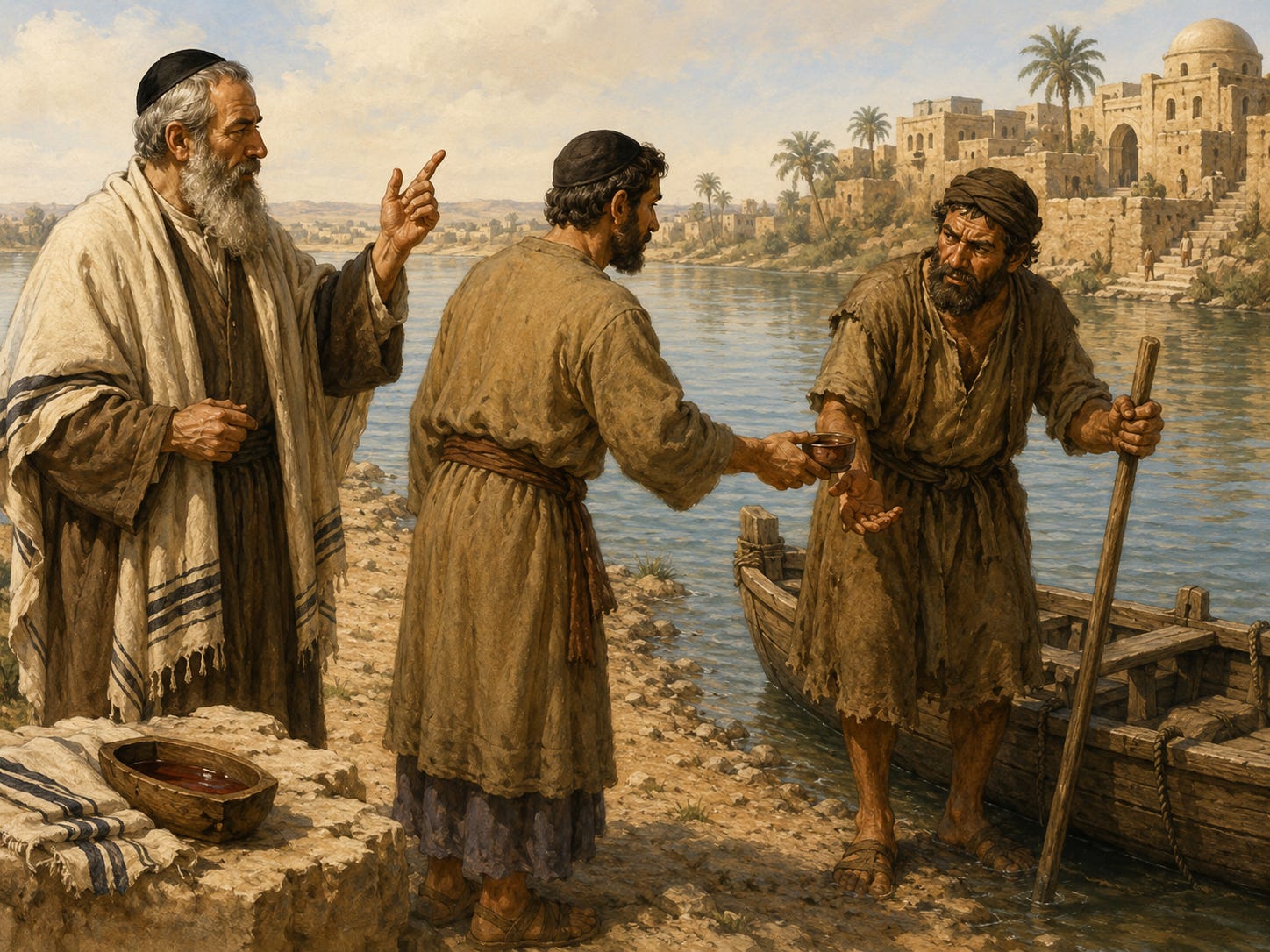
Shmuel, a first-generation Amora, did not explicitly make the statement. Rather, Shmuel was once crossing the river in a ferry and told his attendant to compensate (פַּיְּיסֵיהּ, appease) the ferryman. His attendant did so, and Shmuel was displeased with him. Filling in the details, Abaye, in the fourth generation of Amoraim, had one tradition – that the attendant had given the gentile ferryman a treifa chicken and the ferryman believed it to have been properly shechted. His contemporary, Rava, had a different tradition – that Shmuel told the attendant to give the ferryman (wine) for drinking in an anpaka (a quarter-log vessel), and the attendant gave him (less valuable) diluted wine, thus misleading him.
Importance of Attribution
The Narrator wonders why we bother mentioning that Shmuel’s statement was merely inferred, if the effect is the same. He explains that, according to Abaye’s tradition, that it was a treifa, Shmuel may have been upset because the attendant had kept the chicken in his possession. (That could have led a Jew to accidentally eat it.) According to the Rava tradition, that it was an anpaka of wine, it is because the word “anpaka” refers to undiluted wine. (This might mean that it was more than simply misleading to give the ferryman a different item. Rashi explains that Shmuel could have been concerned with his own honor, as the attendant had thus disobeyed him.) Thus, the Shmuel story need not prove that he actually held this position about geneivat da’at.
While the Narrator fleshed out exactly why, in this case, it was important to distinguish explicit statement from inference, this concern for accurate attribution permeates the entire Talmud. There could always be an alternative impetus for an action or cryptic statement.
Similarly, Amoraim express the importance of giving proper attribution. See Rabbi Yochanan quoting Rabbi Shimon ben Yochai in Yevamot 97a, or Rabbi Eleazar ben Pedat citing Rabbi Chanina in Megillah 15a. Amoraim also dislike when someone is wrongly credited with a statement. In Chullin 50a, some sages mistakenly related a position of Rabbi Yochanan in the name of Rav Nachman, in front of Rava, who was Rav Nachman’s primary student. Rava chastised them, saying “Have I not told you not to hang empty bottles on him?”
Within our sugya, note how, rather than having Shmuel himself proffer the explanation of our Mishnah, the Talmudic Narrator offers it himself. He points us to Shmuel’s position, via דְּאָמַר שְׁמוּאֵל, as justification for his own idea. (We see this concern often, taking the form of “like Rabbi X said, for Rabbi X said”, or when the Narrator suggests how a Sage would answer a challenge, taking the form of “Rabbi X would say to you” instead of a simple “Rabbi X says”. This also follows the Narrator’s typical pattern of almost exclusive reuse of ideas expressed by earlier sources.) And, even there, he notes that Shmuel did not make the statement explicitly.
Import of Anpaka
We might investigate the Narrator’s suggestion that anpaka may connote specifically the more expensive, denser, undiluted wine. In Bava Metzia 86a, refers to an employer’s obligation to provide for his laborer according to local custom, and explains that this means the local custom of workers eating bread and drinking an anpaka (quarter log, or revi’it) of wine. This is ambiguous – since wine is drunk diluted, it might refer to a measure which they then dilute. On the one hand, since this is the drink for a single meal, diluted makes sense. On the other, this meal is a form of payment, much like that to a ferryman.
In Gittin 69b, Rabbi Yochanan states that the cure for drinking uncovered water is to drink an anpaka of undiluted wine, but for a pus-filled wound, one should drink an anpaka of wine steeped in red ice plant. For roundworm, it is an anpaka of wine steeped in laurel leaves. I suspect the Talmudic Narrator drew his possible “undiluted” definition from Gittin, but the fact that anpaka takes a qualifier – a shem levai that does not always accompany it – suggests the opposite to me. The Narrator may respond that, after the first instance, “undiluted” was implicit. Undiluted wine may be generally called for in cures.
Finally, Kiddushin 70a-b records a potentially polemical clash between Rav Nachman and Rav Yehuda. A Nehardean visiting Pumbedita was forced to wait in a butcher shop for the attendant of Rav Yehuda (founder of Pumbedita academy) to be served. He insulted Rav Yehuda, who heard of it and placed the man in cherem and declared that he had slave status. Rav Nachman, who took over Nehardea academy after Shmuel’s death, summoned Rav Yehuda to appear before him to justify himself. Rav Nachman and Rav Yehuda’s interaction can be understood as a competition as to who is more authentic, and who represents the true rabbinic heir to their mutual teacher Shmuel.
One aspect of their competition is linguistic, as Rav Nachman, representing the sophisticated and acculturated Nehardea, uses words like gundarita (little fence), karfita (bench), etronga (citron), and anbaga (cup). In each case, Rav Yehuda, representing the culturally frummer Pumbedita, chastises him for not using the Biblical, Rabbinic, or common folk’s term.
In the last instance, Rav Nachman says “let Master drink an anbaga (of wine)”. Rav Yehuda responds, “Do you detest the word ispargus, which the Sages use, or anpak, which the common people use?” Note that anbaga is linguistically related to anpaka, since the bet and peh are both bilabial plosives (produced with both lips), the difference only being that bet is voiced and peh is unvoiced. Similarly, gimel and kaf (not kuf) share a place of articulation, again with the gimel being voiced. Regardless, it is a loanword. Still, the elite speech was anbaga.
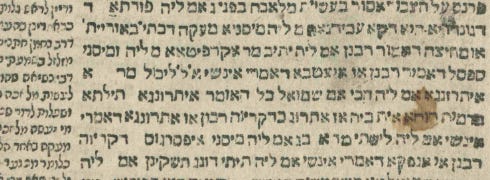
One might argue that anpak and anpaka are distinct. However, the final kametz aleph is usually just a difference in definite vs. indefinite form “the” vs. “a”). Also, while the Vilna and Guadalajara printings, plus the Munich 95 manuscript, have anpak, the Venice printing has the abbreviated אנפק׳. The Constantinople printing and Oxford 367 and Vatican 110-111 manuscripts have anpaka. An abbreviated anpak’ seems like an intermediate scribal step between anpaka and anpak.
The Amoraim typically drank mixed, diluted wine, so if Rav Nachman offered Rav Yehuda an anpaka of wine at the meal, he meant the diluted one. When their mutual teacher, Shmuel, promised the ferryman an anpaka of wine, he used an ambiguous term. In some contexts, like certain cures, and implied as a payment to a ferryman, it means the denser and dearer undiluted wine. In other contexts, such as in meals offered to rabbinic colleagues and perhaps to workers, it means diluted wine. Rava, as Rav Nachman’s primary student who moved to and took over leadership of what was Pumbedita academy, would know the respective connotations, so that the attendant’s action was merely misleading rather than outright theft via non-payment.
The Narrator doesn’t invent the alternatives from whole cloth. Rather, a brayta later on the page (also in Tosefta Chullin 7:1) discusses two reasons not to sell neveilot and tereifot to a gentile, one of which is that he misleads him. The Narrator, in his regular style, extrapolates from and applies the ideas in other contexts. If so, the universal application of geneivat da’at to all humanity precedes Shmuel, a first-generation Amora.