
Stuck In Zevachim?

Have we really left Zevachim. As I discussed in yesterday’s post / article,
the opening sugya in Menachot was a virtual copy of the opening sugya of Zevachim, with a slight change to make it reference a flour offering instead of a meal offering. And, the primary sugya, or actually sugyot, were all well-situated in Zevachim.
Further, the various avodot for a meal offering are patterned after zevach parallels. For instance, the
We can add to this that, within the early discussion in the gemara, we have a potential contrast between positions of Rabbi Shimon ben Yochai, which is predicated on whether he considers Menachot to be patterned after Zevachim.
לֵימָא מַתְנִיתִין דְּלָא כְּרַבִּי שִׁמְעוֹן, דְּתַנְיָא: רַבִּי שִׁמְעוֹן אוֹמֵר: כׇּל הַמְּנָחוֹת שֶׁנִּקְמְצוּ שֶׁלֹּא לִשְׁמָן כְּשֵׁירוֹת, וְעָלוּ לַבְּעָלִים לְשֵׁם חוֹבָה.
§ The mishna teaches that all the meal offerings from which a handful was removed not for their sake are fit for sacrifice but they do not fulfill the obligation of the owner. The Gemara suggests: Let us say that the mishna is not in accordance with the opinion of Rabbi Shimon, as it is taught in a baraita that Rabbi Shimon says: All the meal offerings from which a handful was removed not for their sake are fit for sacrifice and they even satisfy the obligation of the owner.
שֶׁאֵין הַמְּנָחוֹת דּוֹמוֹת לִזְבָחִים, שֶׁהַקּוֹמֵץ מַחֲבַת לְשׁוּם מַרְחֶשֶׁת – מַעֲשֶׂיהָ מוֹכִיחִין עָלֶיהָ לְשׁוּם מַחֲבַת, חֲרֵיבָה לְשׁוּם בְּלוּלָה – מַעֲשֶׂיהָ מוֹכִיחִין עָלֶיהָ לְשׁוּם חֲרֵיבָה.
The baraita continues: Conversely, consecrated animals that were sacrificed not for their sake do not fulfill the obligation of the owner, as in this regard meal offerings are not similar to slaughtered offerings. The difference is that when one removes a handful from a pan meal offering for the sake of a deep-pan meal offering, its mode of preparation proves that it is in fact for the sake of a pan meal offering, as the two offerings differ in appearance. Similarly, with regard to a dry meal offering, e.g., the meal offering of a sinner, which contains no oil, whose handful is removed for the sake of a meal offering that is mixed with oil, its mode of preparation proves that it is for the sake of a dry meal offering, and one’s improper intent is therefore disregarded.
This brings us to an interesting manuscript at the point of transition between Zevachim and Menachot. In the manuscript labeled כי״ח 147
on the Hachi Garsinan manuscript, we see this:
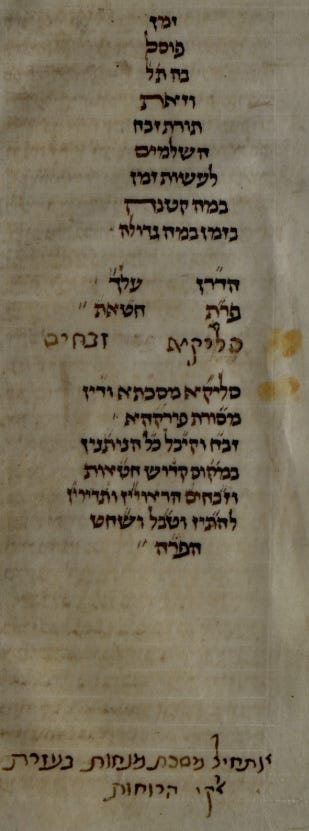
It is interesting that there are two hands working here. In the center, in an empty space, someone added selika zevachim. That same hand added at the bottom atchil masechet Menachot be’ezrat Elokei haruchot, which has a nice poetic ring to it. Both of these additions make it clear — or rather clearer, that we have finished the masechta.
But of course, even without it, the first sofer’s hand made it clear that Zevachim was finished. That is why the words selika masechta appears, followed by a masoret listing out the titles of each perek!
Still, I think the tension of whether Menachot is really a continuation may have played a role in the second hand adding this clarification. Either that, or he copied it from another manuscript which had a more elaborate conclusion and start.