
The Five Rav Kahanas, Part I -- full article

Here is my Jewish Link article for this week. Here, I suggest identifying a certain instance of Rav Kahana as either Rav Kahana I or II. We will overturn that in the continuation next week.
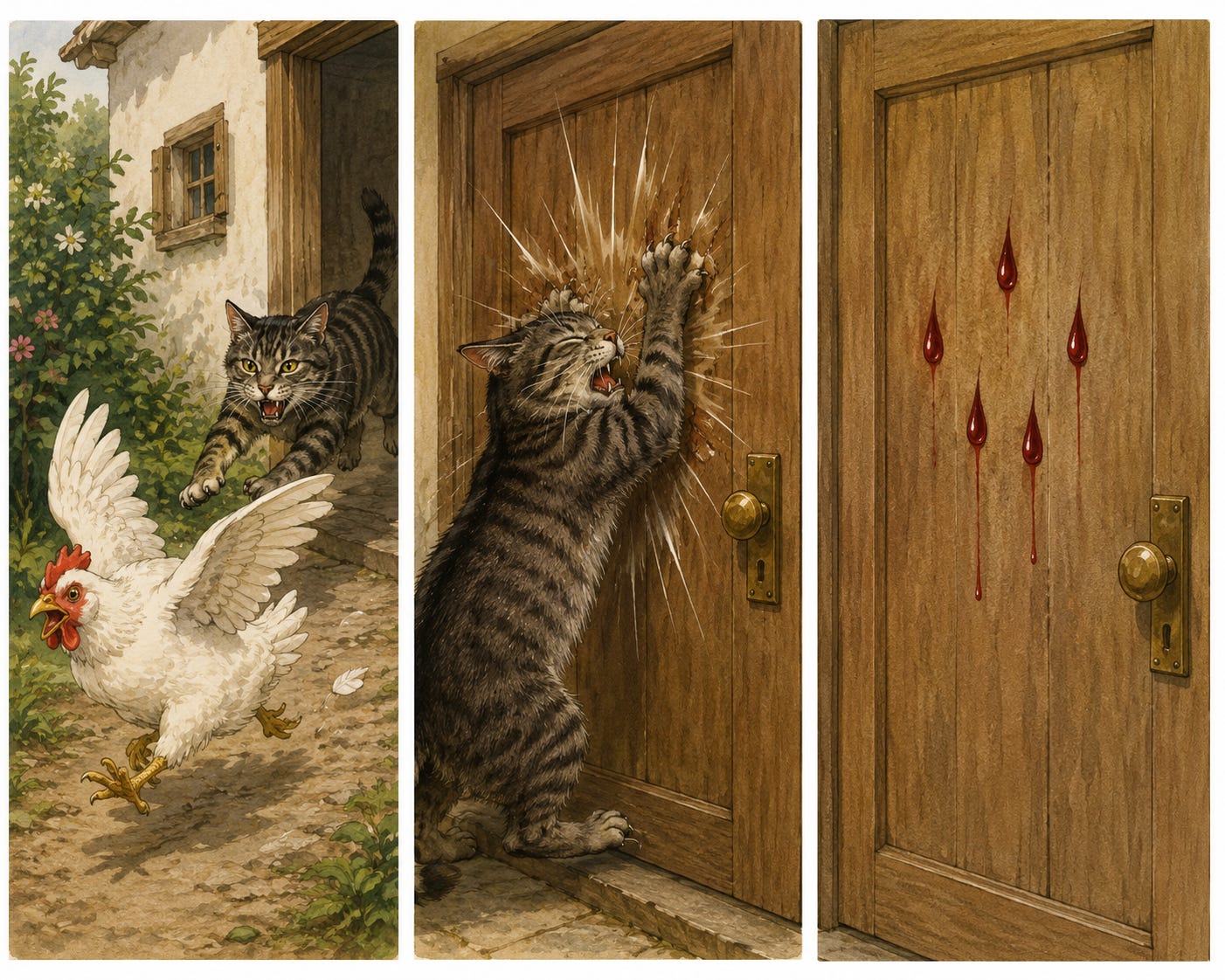
Rav Kahana is a confusing figure, because there are so many of him. That is, Kahana is Aramaic for Kohen, and several Amoraim across several generations bore the name. One of these Rav Kahanas apparently kept chickens or hens. Chullin 52b relates that there was a הָהִיא תַּרְנְגוֹלְתָּא a certain hen, in Rav Kahana’s house. (Tarnegolta is a hen, but other manuscripts have ההוא תרנוגלא, chicken, with a masculine pronoun and masculine noun; other manuscripts have the ambiguous תרנגול׳ paired with either ההוא or ההיא, with the abbreviated form probably serving as a transformative bridge to changing the bird’s gender.) This domesticated bird was pursued by a cat. The door was shut in the cat’s face, and it struck the door with its paws. Afterwards, five drops of blood (interpreted as venom) were found on the door. (Cats have five toes on each front paw and four on each back paw, with a claw on each toe). This story is used to prove various scientific facts about the anatomy and behavior of cats, which has halachic import. But, which Rav Kahana is it?
Rav Kahana I
Rav Aharon Hyman, in Toledot Tannaim veAmoraim, identified five separate Amoraim named plain Rav Kahana, and constructed a biography for each. This was an exercise in educated guesswork. He needed to decide how many such Rav Kahanas existed. There is a limit to how long an Amora lives, but an Amora could potentially span and interact with around three generations. Still, based on interactions with other Amoraim, we could rule out certain possibilities. For an extreme example, if a Rav Kahana is a student of second-generation Rav Huna, it would be surprising for him to behave as a student to sixth-generation Rav Ashi. Once he decided how many Rav Kahanas existed, he needed to examine each sugya and decide which of the plain Rav Kahanas was referenced, again based on sometimes ambiguous clues of interactions with other Amoraim. Using this source material, he could construct a biography of each Kahana. Meanwhile, other Talmudic biographers could interpret the material differently and arrive at different sugya assignments and biographies.
Regarding Rav Kahana I, Rav Hyman relates (my rough translation) that when Rav descended to Bavel in 218 CE, came to Nehardea and afterwards established his famous yeshiva in Sura, all the gedolei hador flocked to him, and some were so great that they were like student-colleagues. He points to Rav Sherira Gaon’s Epistle which lists Rav Kahana Kamma and Rav Asi (of Hutzal) as Rav colleagues. He reinforces this by pointing to Sanhedrin 36b, that Rav Kahana and Rav Asi needed the traditions of Rav but did not need his reasoning. It therefore seems that, for Rav Hyman, any instance alongside Rav Asi is Rav Kahana I. Chullin 52a has Rav Kahana and Rav Asi ask Rav about the legal status of an animal if two ribs attached to a single vertebra were dislocated, with the vertebra itself remaining intact, so this would be Rav Kahana I.
Berachot 62a relates a colorful story of Rav Kahana hiding under Rav’s bed. In that story, Rav demonstrates passion and desire; also Rav Kahana refers to Rav as “Abba.” For Rav Hyman, this designation shows how dear Rav was to him. However, this ties into a broader dispute as to whether “Abba” was a designation or Rav’s actual name. In Pesachim 113a, Rav first speaks to Rav Asi, then stresses the importance of even demeaning work to Rav Kahana, “Skin a carcass in the market and take payment, but do not say ‘I am a kohen’ (kahana ana), or ‘I am a great man (gavra rabba), and this matter disgusts me.’” For Rav Hyman, this demonstrates that Rav Kahana I was a kohen.
Rav Kahana II
According to Rav Hyman, Rav Kahana II was a student of Rav and distinct from Rav Kahana I. Specifically, in Shabbat 152a, Kohelet 12:5 is midrashically interpreted to refer to sexual desire that ceased. Rav sighed when Rav Kahana read this verse before him, which Rav Kahana took as indication that Rav’s desire (for women) had ceased. Rav Hyman thus assumed that this student cannot be the same as the aforementioned student-colleague. To my mind, an alternative could be that the Berachot incident occurred prior to the Shabbat incident.
Chullin 132 relates that Rav Kahana partook of kohanic gifts only because of his wife, who was the daughter of a kohen. The same was true for fifth-generation Rav Pappa, and the same for sixth-generation Rav Yeimar1. Thus, this Rav Kahana was a mere Israelite, not a kohen. In Pesachim 49a, Rav Pappa said, “Had I not married a kohen’s daughter, I would not have become wealthy.” Rav Kahana said, “Had I not married a kohen’s daughter, I would not have been exiled.” (The implication was that he was an Israelite so this was improper.)
Rashi connects this story to Bava Kamma 117a. A man was going to reveal another’s straw to Greek authorities who would seize it. Rav told the man not to do so but the man was rude and defiant. Rav Kahana was sitting in Rav’s presence and broke the man’s neck. Rav advised Rav Kahana to flee to the Land of Israel and study under Rabbi Yochanan, and he did so. Tosafot (in Pesachim, Chullin, and Kiddushin) are troubled by the contradiction, for the exiled Rav Kahana under Rav’s instruction is an Israelite, while we also know that Rav Kahana was a kohen from Kiddushin 8a, where Rav Kahana accepted a turban as the pidyon haben payment which goes to a kohen, deeming it worth five sela. Tosafot in Kiddushin suggest that he could have accepted it by virtue of his wife, but across all three sugyot suggest that there were two Rav Kahanas, with the Israelite who was exiled being Rav’s student, Rav Kahana II. Rav Hyman accepts this distinction. This Rav Kahana later returned to Bavel after the time of Rav and Shmuel, and sat together with other students of Rav, before Rav Huna.
I believe we can resolve Rav Hyman’s contradictions without splitting an Amora in twain. First, in Pesachim 113a, when Rav said to Rav Kahana that one should not say כָּהֲנָא אֲנָא וְגַבְרָא רַבָּא אֲנָא, he may have been engaging in wordplay on Rav Kahana’s name, rather than a kohanic identity. Second, even if that Rav Kahana was a kohen, the exiled Israelite Amora married to a kohen’s daughter in Pesachim 49a and Chullin 132a was another exiled Rav Kahana. This may seem farfetched, but consider that the Amoraic era was unfortunately turbulent. Let us add that, in both Chullin and Pesachim, this Rav Kahana is discussed as marrying a kohen’s daughter in the context of fifth-generation Rav Pappa. Sugyot generally proceed in chronological order of Amoraim’s scholastic generation, yet in Chullin, Rav Kahana precedes and, in Pesachim, Rav Pappa precedes. Third, Tosafot only discuss two Rav Kahanas, but consider that in Kiddushin, when Rav Kahana accepts the turban, it is sixth-generation Rav Ashi who reacts, restricting it to one such as Rav Kahana who is a great man (gavra rabba). One of the later Rav Kahanas was actually Rav Ashi’s teacher, so maybe only this later one was a kohen. (On the other hand, consider the matching of kohanic status and gavra rabba status with the earlier moral instruction from Rav.) The constraints needn’t force us to divide one early Rav Kahana as student-colleague into two figures.
Rav Kahana’s Cat Query
This article began with the story of the cat chasing Rav Kahana’s chicken. Could Rav Kahana I or Rav Kahana II, assuming he is distinct, be the proud chicken owner? It is plausible. After all, immediately following the second telling of the cat story on the daf, the Gemara (and thus the Talmud’s redactors) record a related yet cryptic exchange. To wit, Rav Kahana asked Rav: Does a cat render an animal a tereifa through clawing? Rav replied to him that even a weasel (which is smaller) renders an animal tereifa. (Rav Kahana:) Does a weasel render an animal a tereifa through clawing? (Rav:) Even a cat does not. (Rav Kahana:) Do a cat and a weasel render a tereifa through clawing? (Rav:) A cat does, but a weasel does not. The Talmudic Narrator resolves the apparent contradiction, explaining that each deals with a different case, one involving clawing a bird. The juxtaposition of two Rav Kahana sub-sugyot, on related topics, makes me think we are dealing with the same person.
However, another Rav Kahana appears in the sugya who is associated with sixth-generation Rav Ashi. Indeed, he is mentioned in the sub-sugya immediately after the Rav / Rav Kahana / cat / weasel discussion. In our next column, we’ll consider the biographies of the remaining three plain Rav Kahanas, and whether one of these could be the chicken-owner.
Indeed, Rav Yeimar, like Rav Ashi, was a student of one of the later Rav Kahanas, namely of Pum Nahara, creating a likelihood that this is the Rav Kahana under discussion.