
The Practice of Knife Inspection -- full article

Here is my Jewish Link article for this coming week.
In Chullin 17b, Rav Chisda, a third-generation Babylonian Amora, provides a Biblical basis for inspecting the knife used for shechita. He points to I Shmuel 14:34, where Shaul tells the nation “and slaughter bazeh and eat”. The Talmudic Narrator objects on the spot. After all, Rav Chisda need not seek a Biblical basis. A knife requires examination because a nick in the knife would render the animal a tereifa. Rather, we reframe Rav Chisda as actually asking about the requirement to show the knife to a Sage. That is, when Rav Chisda said בְּדִיקַת סַכִּין, he meant this formal procedure. The Narrator again objects based on Rabbi Yochanan, a second-generation Amora from the Land of Israel, who said that the requirement exists only to show deference to the Sage. The Narrator concludes that indeed, the practice is merely rabbinic, with Rav Chisda’s verse as a mere Scriptural allusion, an asmachta.
The Narrator’s assumption that Rav Chisda and Rabbi Yochanan must be aligned, and therefore harmonized, also appears on Chullin 10b, but as a resolution to a challenge. However, see my earlier Jewish Link article, “Who Heeds You or Your Rabbi?” (December 29, 2022) about how Rav Chisda consistently rejects a Rabbi Yochanan position. Perhaps we need not align their statements. If so, Rabbi Yochanan might treat the practice as mere custom, or agree with our sugya’s conclusion that it is a rabbinic institution, all to promote honoring a Sage. Rav Chisda might consider it as a rabbinically (rather than Biblically) required means of ensuring that the shechita was proper, but wishes to strengthen that via either Biblical precedent or allusion.
Note that Chullin 18a has different approaches towards a shochet who did not show his knife, with (second-generation) Rav Huna merely placing him in shamta and (fourth-generation) Rava also requiring a (presumably accurate) declaration that the meat is treif. The Narrator harmonizes their statements as addressing different scenarios, with Rava dealing with the knife subsequently found to have a nick. That interpretation of Rava’s rule seems to make him make an obvious and unnecessary statement. Perhaps there is a real disparity in understanding the purpose of the rule.
The Verse in Context
Too often when studying Talmud, we encounter a Biblical prooftext and don’t read it inside. We mostly read the short excerpt of the verse. Better is to use Torah Ohr HaShalem on the page of some modern printings and read the full verse. Best is to actually open up our Tanach and see what the verse means in context.
This command by Shaul was triggered by prior events. Shaul’s troops had been fighting the Philistines while fasting, due to an oath imposed upon them not to eat before nightfall. The troops prevailed but were famished, so they pounced upon the spoil, taking sheep, cows, and calves, slaughtering them upon the ground, and then “ate upon the blood”. This religious sin was reported to Shaul who told them that they acted faithlessly, and commanded that a boulder be rolled over to him. Then, he distributed word among the troops that each person should bring his ox or sheep and slaughter it bazeh and eat – thereby they would not sin by eating upon the blood.
Commentators in sefer Shmuel grapple with the meaning of “eating upon the blood”, as well as how shechita at or on the stone solved the problem. The halachic concern could have been that blood slaughtered over ground was absorbed into the meat (Radak); or that they were eating at the very site of slaughter (Ralbag); or that they were slaughtering cattle mothers and offspring on the same day (Rashi, as peshat), or that these were shelamim consumed without zerikat hadam (Rashi citing Zevachim 120). We could analyze what textual cues led to these interpretations, but omit it for space considerations. Regardless, the shechita bazeh at the rock solves the issue.
Rashi there also invokes bazeh as the inspection of the knife. This seems difficult if this is merely an asmachta to a deferential ceremony. In context, Rav Chisda’s בָּזֶה should solve the problem of “eating upon the blood”. This works if a nicked knife would invalidate the shechita, but not if the whole point was to show deference. Further, Shaul gave them the knife he had inspected – they did not bring the knife to him! I would rather that we not harmonize and thereby sap the power of Rav Chisda’s original statement.
Dor Revii’s Commentary
The Chatam Sofer’s oldest daughter Hindel had a daughter Raizel, who had a son, Rabbi Moshe Shmuel Glasner (1856-1924). Thus, Rabbi Glasner was the fourth generation from the Chatam Sofer. One of his works, Dor Revii, is a commentary of Chullin, and is available on Sefaria. Dr. Yaakov Elman provided a translation of parts of the Introduction to Dor Revii as an article in Tradition and also mentioned his approach to Talmud study. Thus, “his independent style of learning with its stress on Rishonim (understood on their own terms), opposition to pilpul and emphasis on the sovereignty of critical thought – was looked upon with disfavor.” Also, “[h]is emphasis on the progressive development of Jewish law is similar in certain respects to aspects of the thought of R. Kook and R. Zadok ha-Kohen of Lublin, but Rabbi Glasner’s schema is less overtly historical than that of the latter, and more halakhic and less mystical than that of the former.”
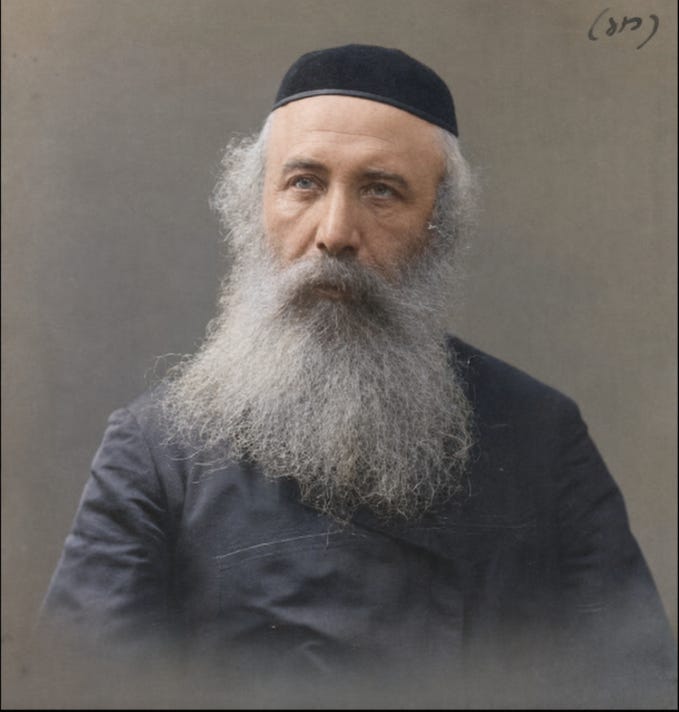
Rav Glasner, the Dor Revi’i, colorized by ChatGPT
We can see how this plays out in his approach to the question of knife inspection, which he discusses in a preface, principle six. He notes that the requirement to inspect the knife is not mentioned in any Mishnah or brayta. Indeed, a Mishnah (Chullin 15b) validates any instrument for shechita except a harvest sickle and saw. Thus, standard knives, even with a nick, are fine. Knife inspection is first mentioned by a late Amora, Rav Chisda, who tries to ascribe it a de’orayta status. One should object that sefer Shmuel, in Neviim, is no basis for Biblical law, and that since “and shecht bazeh” appears there but bazeh is absent in the Torah, this is in fact an addition. Instead, the Gemara objects in the opposite direction, assuming that the inspection requirement is indeed well-grounded and Biblical, for otherwise it would be a treifa, and turns it into an allusion to a deferential act of showing to a sage. Even later generations of Amoraim added many levels of requirements to this inspection.
Rav Glassner asserts that Mishnayot and braytot were composed based on Rabbi Akiva’s initial position, that the majority of the simanim being cut appropriately was all that was required, and therefore a knife was fine even with a notch. Later, Rabbi Akiva retracted from this position, and over different scholastic generations, increasing levels of requirements were added.
After his preface, he has a running commentary on each sugya showing how he understands the text, often in unique ways, so we should not dismiss the preface on the basis of contrary evidence. I still disagree with him, both broadly and in the specifics. For instance, I would point to Rabbi Yochanan, who is explaining an existing and well-established custom. I would not consider Rav Chisda to be such a late Amora, being a third and quasi second-generation Amora. Rav Huna, a second-generation Amora, dealt with a shochet who did not show his knife. Elsewhere (Chullin 9a), Rav Huna dealt with chazaka, in the sense of maintaining the status quo. An animal when alive is forbidden to consume, so it is forbidden until you know bameh nishchata, with what it was slaughtered. That implies knife inspection, even though the Narrator applies the principle there to inspecting the simanim. (Here, Rav Glassner argues that bameh nishchata makes no sense in context, so emends the bet to a kaf to make it kama nishchatah, how it was slaughtered.) Shmuel’s father, who lived in the transitional generation between Tannaim and Amoraim, sent knives (“knives” isn’t actually explicit) to the Land of Israel to get a sense of what level of notch is problematic, until they told him “like a saw”. Rav Glassner interprets that gemara differently as well.
I would not dismiss Dor Revii’s idea that this requirement of knife inspection developed over time. Rather than pointing to a reversal of Rabbi Akiva’s position, I would suggest that a combination of chumra, halachic (re)analysis, and sociological factors caused the practice to expand. It seems plausible to argue that a knife inspection isn’t required, based on chazaka and / or rov. That does not mean that meticulous shochatim would refrain from inspecting their knives before or after. A deferential practice of showing the knife to the local Sage may have evolved from that. Rabbi Yochanan needs to explain that it is not really necessary, because others may have interpreted this as necessary. Rav Chisda’s reaction was more to give the practice a Biblical, if not Torah, basis. His teacher and colleague, Rav Huna, established the status quo argument, so that we actually have to ascertain the knife’s validity to break the animal out of its status quo. The earlier custom / deferential practice was reanalyzed on this basis. The stringencies and particulars then accumulated over progressive scholastic generations.
Good work. Historically, the DR became especially interested in the sugya of bedikat ha-sakin because of a controversy over the arbitrary disqualification by one of the more extreme Transylivania Rabbis of a shochet on the pretext of failure to present his sakin. In advocating for the abused shochet, the DR enlisted the aid of his friend and esteemed colleague the Maharsham, but the effort was futile, because few other rabbis wanted to challenge the right of the local mora d'atra to disqulify a shochet. He wrote an essay "Mishpat la-ashukim" in defense of the shochet and discussed the issue at length in his kuntres "Hlakha le-Moshe".
If I can try to defend the drasha as related to the checking. Pre battle it is explicitly said that Shauls sword was one of two good Israelite swords. Over the course of the battle they obviously captured many philistine swords. Perhaps he saying to use his knife which would have been checked as opposed to captured knives which would not have been checked. (Although I will admit this is forced and a probably bad answer)