
Frankincense Particles?

In today’s daf, at the bottom of Menachot 11a, we read:
חִיסֵּר לְבוֹנָתָהּ. תָּנוּ רַבָּנַן: חָסְרָה וְעָמְדָה עַל קוֹרֶט אֶחָד – פְּסוּלָה, עַל שְׁנֵי קְרָטִין – כְּשֵׁרָה, דִּבְרֵי רַבִּי יְהוּדָה. רַבִּי שִׁמְעוֹן אוֹמֵר: עַל קוֹרֶט אֶחָד – כְּשֵׁרָה, פָּחוֹת מִכָּאן – פְּסוּלָה.
§ The mishna teaches that if one decreased its frankincense beyond its appropriate measure, the meal offering is unfit. Concerning this, the Sages taught in a baraita: If one decreased its frankincense to the point that the amount stood at only one pinch, it is disqualified, but if the decreased amount stood at two pinches, it is fit; this is the statement of Rabbi Yehuda. Rabbi Shimon says: If the decreased amount stood at one pinch, it is fit; less than that, it is disqualified.
This English translation, while generally under Rav Steinsaltz’s direction, is probably off here. They render קוֹרֶט as “one pinch”. Meanwhile, Rav Steinsaltz’s Modern Hebrew translation is גוש קטן, a small lump or cluster. Similarly, the ArtScroll translation of קוֹרֶט is a “particle”, as opposed to a “fragment” (see their footnote), which would be the definition of less than one קוֹרֶט. ArtScroll and Rav Steinsaltz ztz”l in Hebrew are likely correct. And Jastrow says the same:
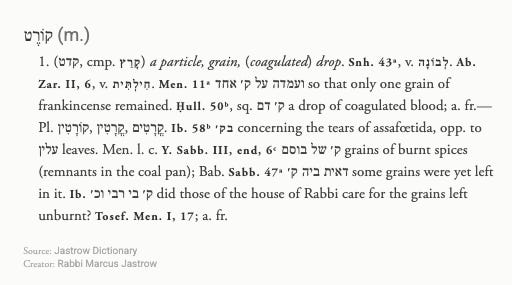
I suspect that this is an instance of semantic shift. If you look up קורט online to find its meaning, you will find three definitions:
The English name Kurt
A food court
A smidgen or pinch
Definition 3 need not be its sense in Chazalic Hebrew. Over time the sense could have shifted to a pinch. Or, perhaps in modern times, when creating Modern Hebrew, they needed a word equivalent to English “pinch” and mined Chazalic Hebrew for it. That situation leads to Modern Hebrew speakers to misinterpret words of the brayta.
While ArtScroll is accurate, they do not define a particle and a fragment, so the reader is left floundering as to the definition of these terms. So, a bit of realia. Frankincense (from Old French franc encens, meaning pure or high quality incense) is the resin from a specific genus of tree, Boswellia.
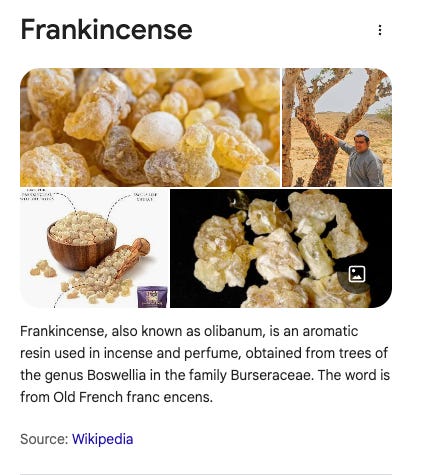
It is the sap of a tree. People tap the tree - that is, they make incisions in the bark. The sap oozes out, and hardens into resin in the form of individual “tears”. See the picture from the Google infobox to see the tree and the tears of frankincense.
Thus, frankincense starts as an oozy liquid. But, since in processing it forms individual units called “tears”, that is presumably the particle which has its own identity. And a “particle” can be of various sizes, but the brayta talks of two such particle units / tears, or just one. And, less than one particle, which ArtScroll calls a fragment, would be the result of a single frankincense tear that has broken apart into fragments. Even though it was originally this thick oozy liquid and we could imagine that it could have hardened into a smaller tear the size of the fragment, that is not what happened. So, experientially, we would say that this is a mere fragment of a tear, not a single tear itself.
Fascinating dive into semantic drift and translation choices. The distinction between particle vs fragment maps nicely onto the physical properties of frankincense tears, where the original unit integrity matters more than arbitrary size. I've seen similar issues with other Chazalic terms that got repurposed for Modern Hebrew and then create confusion when reading ancient texts. The realia angle here realy helps clarify what the brayta is actualy distinguishing.
Is there any connection between קורט & קורטוב?