
Pan-Fried Mincha, ChatGPT, and the Turing Test (full article)

In the zemer of Baruch Kel Elyon, we encounter the following lyrics. הַשּׁוֹמֵר שַׁבָּת, הַבֵּן עִם הַבַּת,
לָקֵל יֵרָצוּ, כְּמִנְחָה עַל מַחֲבַת. An approximate translation of this is: The one who observes Shabbat, the son together with the daughter, they shall be pleasing to God, like an offering upon a machavat, a specific type of cooking vessel. As we study the laws of mincha offerings, we learn that there are several types of meal offerings, as described in various Biblical verses. The Mishnah on Menachot 63a distinguishes between different mincha offerings, because if one vowed to bring one type, he could not bring the other. Rabbi Yossi HaGelili, a fourth-generation Tanna, said that a marcheshet has a cover while a machavat does not. Rabbi Chanina ben Gamliel, another fourth-generation Tanna, who was Rabban Gamliel of Yavneh’s eldest son, said that a marcheshet is a deep pan. Due to the large amount of oil, it moves about (רוֹחֲשִׁין) in within it. A machavat, meanwhile, is flat, so that the sides are level with the pan. Since it has less oil, its product is hard. Thus, there is a difference in consistency of these two types of mincha offerings.
The dispute amongst fourth-generation Tannaim is noteworthy. These Tannaim lived after the destruction of the Temple, so did not experience a Temple marcheshet or machavat firsthand. Perhaps they did not have conflicting traditions, but tried to reconstruct what these vessels must have been. Indeed, consider that Rabbi Chanina ben Gamliel gives an etymology. Could this be his reasoning rather than a proof? The Talmudic Narrator also proposes a speculative etymology for Rabbi Yossi HaGelili, but probably retracts it. Also, note that Rabbi Yossi HaGelili was from the Galilee, in the north of Israel, while Yavneh is further south than that, about parallel to Jerusalem. There are linguistic differences between these places, so maybe each Tanna simply attested to the meaning of the term where they lived, assuming it carried the same meaning.
Why Specifically Machavat?
Is there something specific to a mincha made in an uncovered pan, or in a shallow pan, or without much oil, that relates specifically to keeping the Shabbat? Why should Hashem desire / accept Shabbat observance like this mincha. Although one cannot be substituted for the other, is there any sense that one is actually preferred to the other?
This curious line has surely sparked all sorts of deep and homiletic explanations as well as shaleshudes Torah. Some of these explanations might even be true. For instance, Rav Yitzchak Isaac Taub of Kalov invoked the principle of echad hamarbeh ve’echad hamam’it, whether more or less, being acceptable. People keep Shabbat at different levels, with the “son” being the higher level and the “daughter” the less. The mincha is less costly than other offerings. Perhaps I am adding that the machavat offering had less oil. Rav Elyah Lopian contrasted the soft dough produced by the marcheshet with the hard from the machavat, so that even if it is dry like a machavat offering, it is accepted by Hashem. (As far as peshat goes, I would have said that the author’s intent was to designate something really wonderful and optimal.) Rav Chaim Kanievsky invoked the idea that minchat marcheshet atoned for sins of thought, while minchat machavat atoned for sins of speech such as leshon hara1. Shabbat 118b has Rabbi Yochanan assert that observing the Shabbat properly atones even for idolatry as grievous as in the generation of Enosh. Thus, the paytan tagged the mincha al machavat as atoning even for sins of action.
However, the simplest, pragmatic, and most straightforward answer is that machavat rhymes with Shabbat and bat, and the rhyme scheme of this chorus is AABA. Compare with כָּל שׁוֹמֵר שַׁבָּת / כַּדָּת מֵחַלְלוֹ / הֵן הֶכְשַׁר חִבַּת / קֹדֶשׁ גּוֹרָלוֹ, which is ABAB. Had the poet, Rabbi Baruch ben Shmuel of Mainz, needed to rhyme with keshet and yoshevei Pileshet, it is quite possible that Hashem would accept it like a mincha bemarcheshet. The same for the flowery language הַבֵּן עִם הַבַּת. He might mean “man and woman”, but selected from an inventory of possible words and synonyms the phrase that had the right meter and rhyme.
I asked a few large language models this question, to see if they would mention that it rhymes. Claude Opus 4.6, ChatGPT (even with Deep Research turned on), and Grok all failed to suggest the rhyme scheme explanation at first, but all three could be steered into acknowledging it as the sole or as a contributory explanation. Of course, sycophancy is a problem with many LLMs, so they might just have been agreeable. Read the conversation logs and form your own opinion.
LLMs and the Turing Test
I thought to conduct this test because LLMs are getting more and more capable, in tasks ranging from writing computer programs to generating videos, and from constructing mathematical proofs to producing pesak halacha. Are the LLMs “intelligent”? Relatedly, but not necessarily the same thing, can they pass the Turing Test?
In a 1950 paper in the journal Mind, Alan Turing considered the question of artificial intelligence, and then proposed replacing the question “can machines think?” with the question of whether machines could successfully play the “Imitation Game”. That is, the inner process did not matter so much as whether the machine could exhibit the same behavior as a thinking human individual. The game is played by (A) a machine, (B) a human, and (C) a human interrogator sitting in a separate room from the other two2. The interrogator can ask A and B questions, ideally via teleprinter. At the end of the game, C must identify one of (A, B) as human and the other as a machine. B’s goal is to help with the correct identification while A’s goal is to fool the human.
Over the years, there have been many claims that bots or other forms of AI have passed the Turing Test. For instance, Eugene Goostman is a chatbot developed in 2001 that pretended to be a Ukrainian 13 year old boy. In this way, people would attribute its lack of knowledge and grammar errors to his youth and that English was not his native language, rather than simplistic chatbot programming. In a contest in 2012, it fooled 29% of judges. A study published in the Proceedings of the 2025 ACM Conference was titled “People cannot distinguish GPT-4 from a human in a Turing test”. Online participants had a 5 minute conversation with various chatbots (ELIZA, GPT-3.5, GPT-4, GPT-4o) as well as humans. The participants identified GPT-4 as human 55% of the time, actual humans as human 71% of the time, and GPT-4o as human 77% of the time. Note that current large language models are far more advanced than GPT-4o.
The point of the Imitation Game is not to see how well a chatbot is at the task of tricking a human! The point is to use readily observable external traits as a proxy for internal assessment of intelligence. Pretending to be a young Ukrainian sidesteps the need to exhibit traits of intelligence. I’m also not sure that the interrogators in the other study had read Turing’s paper and were trained enough to understand their assignment and possible strategies. Regardless, consider this excerpt from Turing’s article, of the level of discourse and follow-up he expected..
Interrogator: In the first line of your sonnet which reads “Shall I compare thee to a summer’s day,” would not “a spring day” do as well or better?
Witness: It wouldn’t scan.
Interrogator: How about “a winter’s day,” that would scan all right.
Witness: Yes, but nobody wants to be compared to a winter’s day.
Interrogator: Would you say Mr. Pickwick reminded you of Christmas?
Witness: In a way.
Interrogator: Yet Christmas is a winter’s day, and I do not think Mr. Pickwick would mind the comparison.
Witness: I don’t think you’re serious. By a winter’s day one means a typical winter’s day, rather than a special one like Christmas.
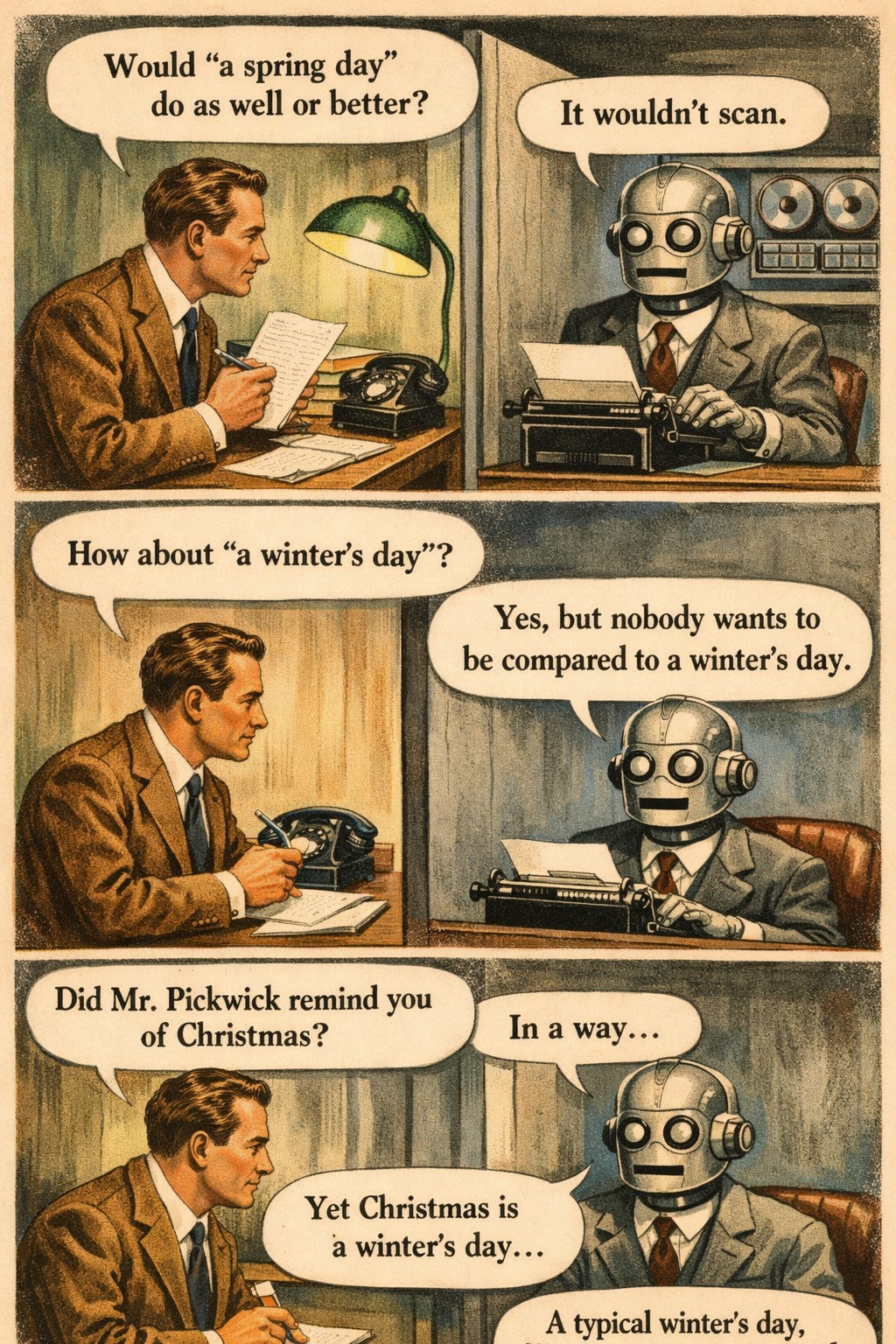
That exchange came to mind when considering these modern LLM responses. No LLM leapt to the explanation of the rhyme scheme. I would consider this failing the Turing Test. On the other hand, maybe I’m wrong about the rhyme scheme explanation. Further, people have pointed out that the machines should be compared to humans at the same task. Perhaps most humans would not consider rhyme (and meter, syllable count, etc.) in analyzing this piyut. Still, the true challenge for modern LLMs, then, is not in demonstrating intelligence by performing complex tasks, but in exhibiting the intuitive and sometimes simple lateral thinking that defines human-level understanding. After all, the insight that machavat rhymes with Shabbat is not a deep theological discovery. It is simply a poet’s pragmatic ear at work, and the failure to recognize that may be the most revealing thing an LLM can do.
This is based on the Talmudic Narrator’s speculative analysis of Rabbi Yossi HaGelili. The Narrator attacks this supposition by producing an equally compelling speculative analysis producing reverse identifications, and concludes that Rabbi Yossi HaGelili is based on a (material or linguistic) tradition. Admittedly, Meorot HaGra asserts the gemara didn’t retract, and the conclusion was that the speculative analysis was a tradition. Still, the Rambam rules like Rabbi Yossi HaGelili’s opponent, so the marchashet is deep, not covered. This is because the position is more compelling and accords with Beit Hillel’s tradition later in the sugya.
Turing first introduced the game with a man, a woman, and an interrogator, but then had a machine replace the man